The 5-Phase Startup Growth Framework Every Founder Should Follow Before Scaling
The 5-Phase Startup Growth Framework Every Founder Should Follow Before Scaling
A B2B SaaS go-to-market strategy template helps founders turn their product, target audience and growth goals into a structured market-entry plan. But before scaling, startups also need to understand whether their positioning, acquisition channels, revenue model and retention systems are ready to support growth.
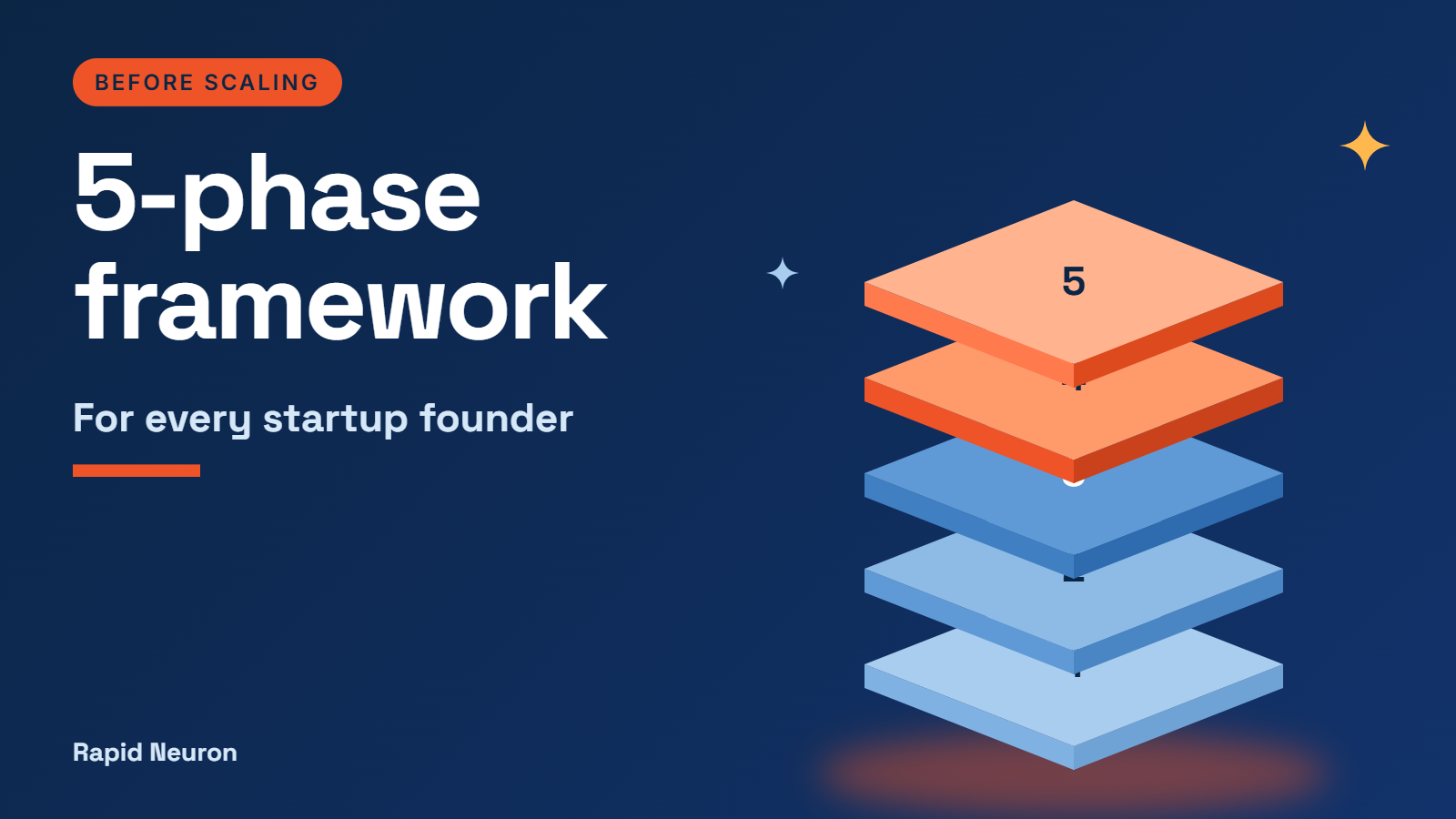
This five-phase startup growth framework covers Foundation Clarity, Channel Validation, Revenue Architecture, Retention Engine and Scale Readiness Assessment. Together, these phases help founders identify gaps, prioritise improvements and build a stronger foundation for sustainable growth.
The 5 Phases of the Startup Growth Framework
- Foundation Clarity – Define exactly what you sell and to whom
- Channel Validation – Identify acquisition channels that produce real customers
- Revenue Architecture – Align pricing and packaging with long-term growth
- Retention Engine – Fix churn before increasing acquisition
- Scale Readiness Assessment – Confirm operational and economic stability
Each phase builds on the one before it. Skipping steps creates growth debt – and growth debt is expensive.
Let’s break it down.
Phase 1: Foundation Clarity
Question: Do you clearly know what problem you solve and for whom?
Most founders think they do. Few can explain it in one sentence that customers can repeat back accurately. Foundation Clarity is the first step in any serious startup scaling strategy. Without it, marketing becomes guesswork.
This phase focuses on:
- Defining a sharp value proposition (one sentence, no jargon)
- Identifying a specific Ideal Customer Profile (behavioral, not just demographic)
- Interviewing both buyers and non-buyers to test positioning
- Aligning messaging across marketing, sales, and product
If you can’t describe your customer in detail, what triggers them to look for a solution, what alternatives they consider, and what makes them hesitate, you’re not ready for aggressive acquisition.
Output of Phase 1: A working positioning document that guides every growth decision. For example, a broad ICP such as “small businesses” gives a startup very little direction. A more useful ICP identifies the type of business, its specific problem, the trigger that makes it seek a solution, and the people involved in the buying decision.
A practical positioning document should capture five things: the target customer, the problem being solved, the value proposition, the alternatives customers consider, and the reasons they may hesitate to buy.
Without clarity, scaling just means spending money faster to attract the wrong audience.
Phase 2: Channel Validation
Question: Which one or two channels reliably produce profitable customers?
Startups often try to be everywhere – paid ads, SEO, partnerships, cold outreach, events — all at once.
That’s not a startup growth methodology. That’s a distraction.
Channel Validation is about running controlled, time-bound experiments to discover which channels generate customers who:
- Convert at an acceptable cost
- Stay beyond onboarding
- Deliver strong lifetime value
Many teams optimize too early for cost-per-click or cost-per-lead. Those numbers don’t tell you if the customer will stay.
Instead, measure channels on four criteria:
- Customer acquisition cost (CAC)
- Time to conversion
- Retention quality indicators
- Payback period
A channel that produces fewer but higher-intent buyers will almost always outperform high-volume, low-quality traffic once you scale.
Output of Phase 2: A ranked channel hierarchy that defines where to invest — and where not to. For example, a startup may receive more leads from paid advertising than from SEO, but lead volume alone does not establish which channel is better. Compare the channels based on customer acquisition cost, time to conversion, retention quality and payback period.
The goal is to identify which channel brings customers who convert, stay and generate enough value to justify the acquisition cost.
If you don’t validate channels first, your startup’s scaling strategy becomes expensive experimentation.
Phase 3: Revenue Architecture
Question: Is your revenue model built to support scale?
Many startups land on pricing accidentally. A founder names a number in an early sales call, and it sticks.
But what worked for your first 10 customers may break at 100.
Revenue Architecture examines three core elements:
1. Pricing Logic
Is your pricing based on delivered value, or fear of losing deals?
2. Packaging Structure
Do your plans reflect how customers actually want to buy? Or are they structured for internal convenience?
3. Expansion Path
Can customers grow their spend naturally over time without being resold from scratch?
Misalignment here shows up as:
- Long sales cycles
- High churn
- Poor upsell rates
- Heavy discounting
If your best customers don’t have a clear expansion path, scaling only increases customer acquisition, not revenue quality.
Output of Phase 3: A refined pricing and packaging structure aligned with long-term growth. Consider a SaaS company with a single pricing plan for every customer. As customer requirement become more complex, this structure may limit its ability to serve different segments or increase account value.
A more deliberate revenue architecture connects pricing to delivered value, packaging to customer needs, and expansion options to how customers grow over time. The right structure depends on the product, customer segments and buying behaviour.
A strong revenue model turns growth from linear to compounding.
Phase 4: Retention Engine
Question: Are customers staying long enough to justify acquisition costs?
Retention is where many startups quietly struggle.
Acquisition is exciting. Retention feels operational. But if you’re losing 30–40% of customers within the first 90 days, you don’t have a scaling problem; you have a leakage problem. If a significant number of customers leave within their first 90 days, investigate the reasons before increasing acquisition. Early churn may indicate problems with onboarding, product value, customer expectations or engagement.
This phase maps the customer journey beyond the sale:
- Onboarding experience
- First success milestone
- Early usage patterns
- Support interactions
- Communication gaps
Customers churn for specific reasons:
- Product gaps
- Expectation mismatches
- Poor onboarding
- Lack of engagement triggers
Each requires a different solution.
Strong retention improves everything:
- Lower CAC pressure
- Higher lifetime value
- More referrals
- Stronger unit economics
Output of Phase 4: A documented retention playbook, clear triggers, interventions, and engagement checkpoints. To identify retention problems, review the customer journey after purchase. Check whether customers complete onboarding, reach their first success milestone, use important product features and receive timely support.
These signals help teams investigate why customers disengage. For example, low product usage may point to an onboarding or activation issue, while repeated support complaints may reveal a product gap or an expectation mismatch.
Before asking how to grow a startup faster, ask whether customers are staying long enough to make growth sustainable.
Phase 5: Scale Readiness Assessment
Question: Are you truly ready to scale, or just eager to?
This is the final gate in the startup growth framework. Scaling requires evidence, not optimism.
You should confidently answer “yes” to these:
- We know who our best customers are
- We have 1–2 channels that consistently acquire them profitably
- Our pricing captures the value we deliver
- Churn is stable or improving
- Our systems and team can handle 3× current volume
If your answers are “maybe” or “we think so,” scaling will amplify instability.
This phase functions as a pre-scale checklist for startups, a disciplined review of whether the engine is strong enough for acceleration.
Output of Phase 5: A Scale Readiness Score that highlights what must be fixed before serious investment. Utilise the readiness questions above as a practical pre-scaling checklist. For each question, record the evidence supporting your answer rather than relying on assumptions.
If a channel is not consistently profitable, churn is still rising, or the team cannot handle additional customer demand, document the gap and assign a corrective action before increasing investment.
The assessment should help founders identify what is ready, what remains uncertain and what needs to improve before scaling.
Growth should feel repeatable before it feels aggressive.
Why Sequencing Matters
The power of this startup growth framework isn’t just the phases; it’s the order.
- Strong channels can’t compensate for weak positioning.
- Good retention can’t fix broken pricing.
- Clear positioning won’t matter if acquisition channels don’t convert.
Each phase reduces risk. Each builds leverage for the next.
When startups follow structured growth phases instead of chasing tactics, scaling becomes controlled multiplication, not chaotic expansion. The sequence also helps founders prioritize decisions. There is little value in increasing acquisition before understanding which customers are the right fit. Similarly, bringing in more customers will not solve a retention problem or fix a revenue model that does not support long-term value.
Review each phase before moving to the next. If an earlier phase reveals a weakness, address it before committing more resources to growth.
What This Looks Like in Practice
When startups apply this framework correctly:
- Acquisition becomes more predictable
- Sales cycles shorten
- Retention stabilizes
- Expansion revenue increases
- Growth compounds instead of resetting every quarter
Instead of constantly fixing what broke during the last growth push, teams build momentum that holds under pressure.
That’s the difference between growth spikes and growth systems. These are potential outcomes, not automatic results. They depend on the startup’s market, product, execution and ability to address weaknesses across all five phases. The framework provides a structured way to evaluate those factors before committing to faster growth.
Before You Hit the Gas
Scale is not the goal. Scale is what happens when everything else is working.The founders who build lasting companies aren’t the ones who scaled first. They’re the ones who built something structurally sound before accelerating.
If you’re thinking about aggressive hiring, increasing ad spend, or expanding into new markets, pause.Go through the phases. Diagnose where you are. Fix what’s fragile. Then scale.
Before increasing ad spend, hiring or entering a new market, review all five phases. Identify the weakest area, decide what needs to change, assign responsibility and track whether the issue is improving. Move towards scaling when your decisions are supported by consistent evidence rather than a few good months.
Ready to See Where You Stand?
Understanding where your startup stands is the first step towards building a more sustainable growth system.
If your team has identified what is holding back growth but needs help turning those findings into an actionable plan, explore Rapid Neuron’s business growth consulting to assess priorities, execution and performance measurement.
Growth should be deliberate, measurable and built on a foundation that can support the next stage.
Get Growth Diagnosis
Find out what is holding your growth back and how to fix it.