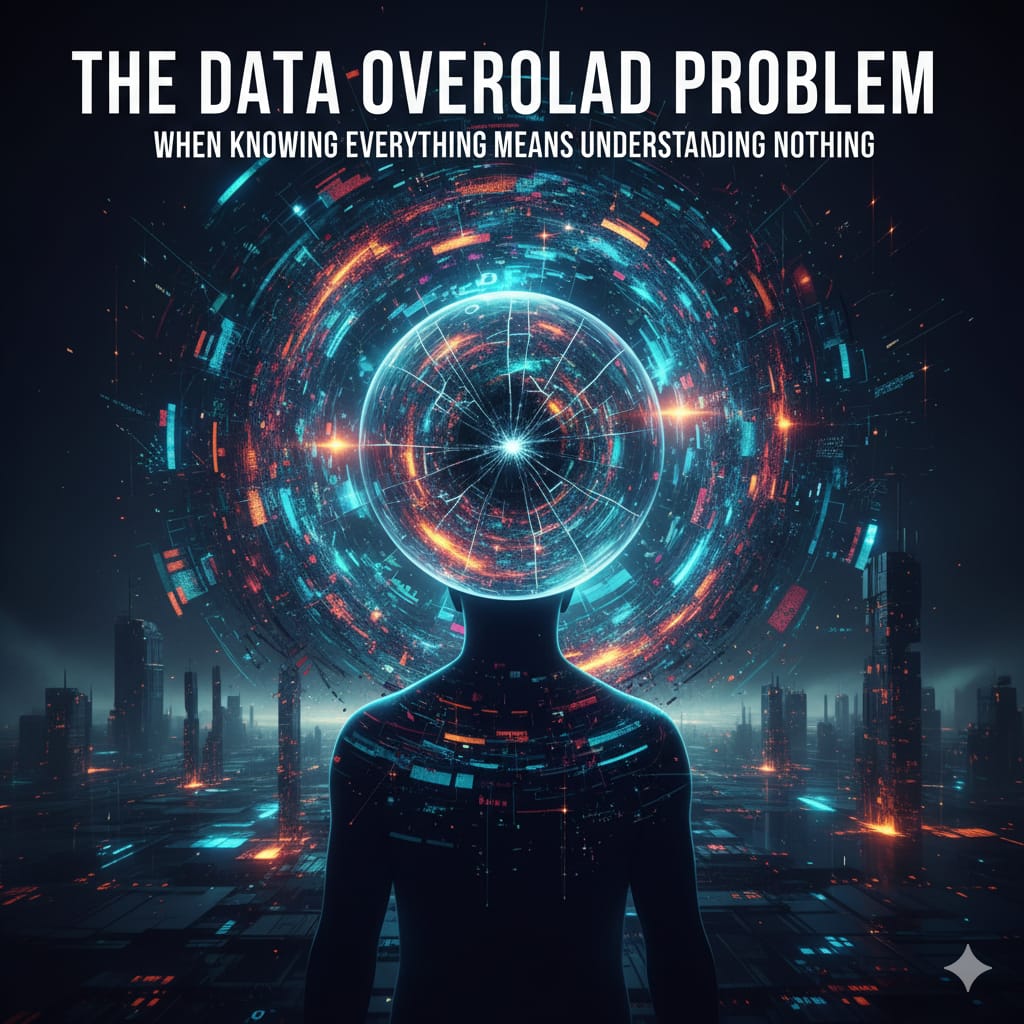
The Data Overload Problem: When Knowing Everything Means Understanding Nothing
We live in an era where every company claims to be “data-driven.”
Dashboards track everything from website clicks to employee response times.
Every decision is backed by a spreadsheet, a metric, a KPI.
And yet, most founders will admit
“We have tons of data, but we’re still guessing.”
That’s the paradox of modern growth.
We’ve never had more information and yet, we’ve never felt more uncertain.
This is the Data Overload Problem, and it silently kills more startups than a lack of funding ever could.
The Illusion of Clarity
When your business starts scaling, it’s tempting to measure everything.
Leads. Conversions. MRR. Retention. CAC. LTV.
Then you add engagement metrics, sales KPIs, project trackers, pipeline forecasts…
Within months, your company starts generating data noise endless signals with no clear story.
It feels like control.
You believe, “If we can measure it, we can manage it.”
But in reality, you end up managing dashboards instead of outcomes.
Data gives comfort, but not clarity.
The more metrics you add, the less focus you have on what truly matters.
Why This Happens: The Founder Psychology Behind It
Let’s be honest founders don’t chase data because they love spreadsheets.
They chase it because it gives the illusion of certainty in an uncertain world.
When growth is unpredictable, data feels like an anchor.
You open dashboards at midnight not because you want to but because you’re searching for proof that things are working.
This behavior comes from a natural founder instinct:
The need for control
The need to see cause and effect
The fear of “missing something”
But that instinct, unchecked, leads to data obsession and then paralysis.
You start analyzing instead of deciding.
You start collecting instead of acting.
The business drowns in numbers that tell you what happened but not what to do next.
The Hidden Cost of Data Overload
Let’s break down how this problem quietly eats away at company performance:
1. Decision Fatigue
When you have too many metrics, every decision feels like a debate.
Teams spend more time aligning on “which number matters” than actually improving it.
2. Reactive Leadership
Data makes you reactive if you don’t know what to prioritize.
You end up chasing every drop in a graph instead of seeing the broader trend.
3. Lost Focus
Every department starts optimizing for its own metric marketing for reach, sales for speed, product for adoption and suddenly the whole company’s energy scatters.
4. Poor Morale
When teams don’t know which metric defines success, they stop feeling successful.
Confusion breeds burnout faster than failure.
The Core Truth: Not All Metrics Are Equal
Every company must face this uncomfortable truth:
More data doesn’t mean more insight.
In fact, great companies do the opposite they simplify relentlessly.
Look at the world’s most successful organizations:
Amazon tracks a handful of “controllable input metrics.”
Netflix focuses on “viewer satisfaction” and “time to enjoyment.”
Apple measures “time to value” for every new user experience.
They don’t look at everything.
They obsess over a few things that define their version of success.
That’s the difference between data-driven companies and insight-driven companies.
Data-driven teams collect.
Insight-driven teams interpret.
The Framework: How to Escape Data Overload
If you’re drowning in dashboards, here’s a way out.
Step 1: Define Your “North Star” Metric
Ask: What single measurable outcome reflects true growth for us?
It’s not revenue. Revenue is a result.
It’s the one metric that predicts long-term success e.g.,
For SaaS: active paid users
For a D2C brand: repeat purchase rate
For an agency: client retention or lifetime value
Everything else should orbit around this number.
Step 2: Identify Leading vs. Lagging Indicators
Most founders obsess over lagging metrics revenue, churn, profit which show what already happened.
Leading metrics like demo-to-conversion rate or customer satisfaction tell you what’s about to happen.
Focusing on leading indicators lets you act before problems hit your P&L.
Step 3: Build a Hierarchy of Focus
Not every metric deserves equal attention.
Create three layers:
- North Star Metric (1)
- Supporting Metrics (3–5)
- Diagnostic Metrics (tracked, not managed)
This hierarchy prevents your team from reacting to every blip in the data.
Step 4: Simplify Your Reporting Rhythm
Replace daily chaos with structured weekly reviews.
One meeting for key growth metrics.
One meeting for operational health.
Everything else? Automated dashboards for reference not reaction.
Step 5: Train for Data Literacy, Not Just Collection
Most data problems aren’t technological they’re interpretational.
Your team should understand why a metric matters, not just what it says.
This builds intuition, not dependency.
The Founder’s New Relationship With Data
When you simplify your data structure, something magical happens:
Your team starts focusing again.
Decision-making accelerates.
Conversations shift from “what happened” to “what’s next.”
Founders often rediscover mental clarity once they stop being slaves to metrics.
They start recognizing patterns not just numbers.
Because data should never dictate your intuition.
It should refine it.
The Big Picture
Data is powerful. But power without direction leads to distraction.
If your company’s growth feels stuck despite having more information than ever, the problem isn’t your analytics tool.
It’s your relationship with clarity.
Simplifying data is not about tracking less it’s about seeing more.
It’s about giving your team permission to focus on what matters.
The companies that win are not the ones that measure everything they’re the ones that understand what to ignore.
Reflection for Founders
Ask yourself these:
Which 3 metrics would I track if all dashboards disappeared tomorrow?
Do I know which numbers actually influence my long-term growth?
Am I leading with data or hiding behind it?
Clarity isn’t in the data.
It’s in how you choose to see it.