
How to Build a Repeatable B2B Sales Playbook from Scratch
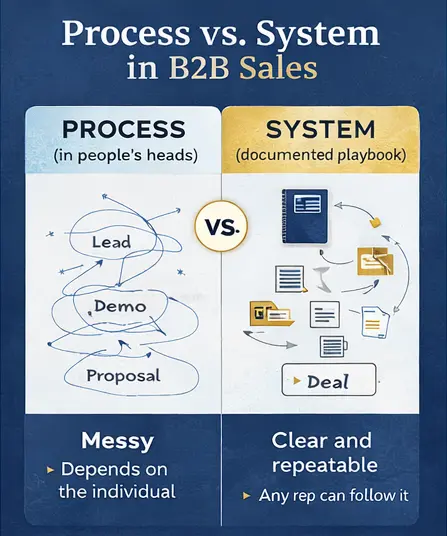
Most B2B sales teams have a process, but very few have a system. There’s a big difference. A process exists in people’s minds, while a system is documented so that any rep can understand, follow, and succeed with it. That document is your sales playbook.
If your revenue relies on a few star performers doing things their own way, you don’t have a scalable business. You have a fragile one. A well-designed B2B sales playbook can make a significant difference. It distils what your best sales reps do naturally and turns it into something teachable, repeatable, and measurable.
Here’s how to build one from scratch.
What Exactly Is a B2B Sales Playbook?
It is the sales operating manual to win deals. It includes the audience you’re targeting, the way you engage them, the words you use at each step, and the way you respond to objections. It is part strategy and part toolkit, and when done right, it can be the heart of your entire revenue operation.
A good sales playbook answers these questions with certainty:
- Who is our ideal customer?
- How do we transition them from strangers to signed contracts?
- What does success look like at every step?
Why Most Teams Can't Scale Without One
Here’s a pattern that plays out at growing companies all the time: sales are going well, you hire more reps, and suddenly your numbers get unpredictable. Some reps crush it. Others struggle. And nobody’s quite sure why.
The issue usually isn’t talent; it’s the absence of structure. Without a playbook, every rep is improvising. And improvisation doesn’t scale.
With a solid B2B sales playbook, you get:
- Faster ramp times – New hires stop relying on tribal knowledge and start closing sooner.
- Consistent messaging – Every prospect hears a story that reflects your brand and value proposition.
- Easier coaching – Managers can identify exactly where a deal breaks down and fix it.
- Better win rates – Because the team is using what works, not guessing.
Building Your B2B Sales Playbook: Step by Step
Step 1 - Know Exactly Who You're Selling To
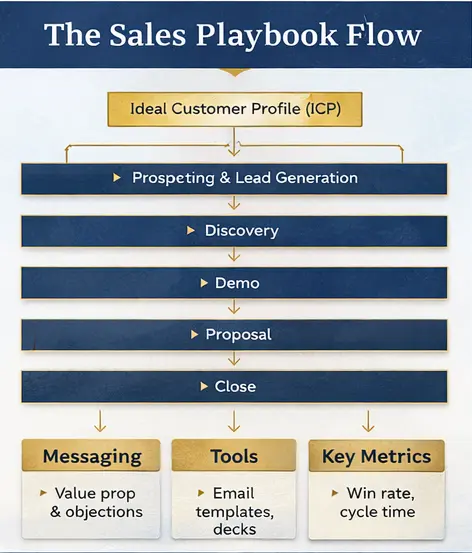
Before anything else, nail down your Ideal Customer Profile (ICP). This isn’t just “companies that could use our product.” It’s specific to industry, company size, revenue range, team structure, and the pain points your solution directly addresses.
Pull data from your CRM. Look at your best customers, the ones who signed quickly, stayed long, and expanded. What do they have in common? That’s your ICP.
Step 2 - Document Your Sales Process Stage by Stage
Map out every stage from first contact to closed deal. For most B2B teams, that looks something like:
- Prospecting and lead generation.
- Discovery and qualification.
- Product demo or solution presentation.
- Proposal and negotiation.
- Closing and handoff to onboarding.
For each stage, define two things: what needs to be true for a deal to enter that stage, and what needs to happen for it to move forward. This kills the habit of reps carrying dead deals indefinitely.
Step 3 - Build Your Messaging Framework
Your reps shouldn’t have to reinvent the pitch every time. Give them a messaging foundation that covers:
- Your core value proposition – What problem you solve and why it matters now
- Key differentiators – What makes you a better choice than doing nothing or going with a competitor
- Persona-specific pain points – CFO cares about different things than a VP of Sales
Objection responses – For the pushbacks you hear constantly (price, timing, “we already have something”)
Good messaging isn’t a script. It’s a framework reps can make their own while staying on point.
Step 4 - Arm Your Team with the Right Tools
Every asset should be grounded in what is worked, not what sounds good in theory.Your playbook should include a library of ready-to-use assets:
- Cold outreach email sequences and LinkedIn messages.
- Discovery call question guides.
- Demo presentation decks.
- Proposal templates.
- Case studies organised by industry or use case.
- ROI calculators or business case builders.
Every asset should be grounded in what is worked, not what sounds good in theory.
Step 5 - Define What Good Looks Like with Real Metrics
A playbook without measurement is just a document people read once and forget. Tie your playbook to real KPIs:
- Lead response time.
- Discovery-to-demo conversion rate.
- Average sales cycle length.
- Win rate by stage, persona, and deal size.
When reps know what benchmarks to aim for, they have a clear target. And when managers review performance, they know exactly where to coach.
Step 6 - Keep It Alive
This is where most playbooks fail. They get built, celebrated, and then ignored six months later because nobody updated them.
Set a quarterly review, assess what’s working, retire what isn’t, and add new content based on recent wins and losses. Assign someone ownership of the playbook. Without an owner, it goes stale.
Mistakes That Will Sink Your Playbook Before It Starts
- Building it alone – Your top reps know things you don’t. Loop them in early.
- Making it too long – If no one reads it, then it is useless.
- Skipping the data – It should be based on deal intelligence from your CRM, not your gut.
- Treating it as final – The market changes, the way the buyer behaves changes, and the products change. So should the playbook.
The Bottom Line
A repeatable B2B sales playbook is more than just helping your sales teams close more deals today. It is the foundation on which future growth can be achieved without breaking the sales system every time you try to scale.
It is one of the highest leverage activities a sales leader can invest their time in.
Start with where you are today and make your best attempt at documenting the current best way of doing things. Then iterate from there.
At Rapid Neuron, we specialize in helping sales teams develop the strategies, frameworks, and systems needed to achieve predictable and scalable revenue growth.
If you’re ready to take your sales operation to the next level, then let’s talk.