
How to Build a Repeatable B2B Sales Playbook from Scratch
How to Build a Repeatable B2B Sales Playbook from Scratch
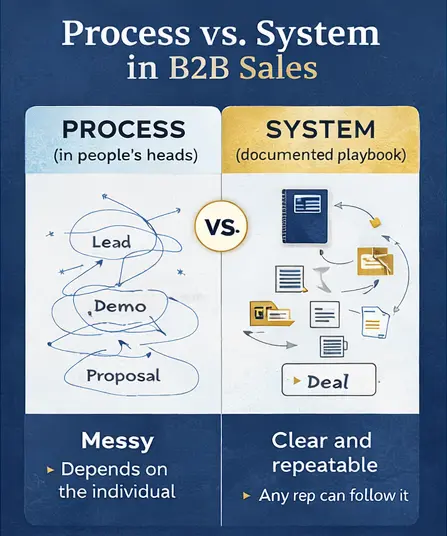
A SaaS sales playbook is a documented guide that helps B2B sales teams follow a consistent pipeline for identifying prospects, conducting conversations, handling objections and closing deals. It turns individual sales experience into a repeatable system that representatives can use across the customer journey.
For growing SaaS businesses, this creates greater consistency in sales execution, makes it smoother to onboard new representatives and gives managers a clearer way to measure performance. This guide explains how to build a repeatable B2B sales playbook, from defining your ideal customer profile to documenting sales stages, messaging, tools and performance metrics.
What Exactly Is a B2B Sales Playbook?
It is the sales operating manual to win deals. It includes the audience you’re targeting, the way you engage them, the words you use at each step, and the way you respond to objections. It is part strategy and part toolkit, and when done right, it can be the heart of your entire revenue operation.
A good sales playbook answers these questions with certainty:
- Who is our ideal customer?
- How do we transition them from strangers to signed contracts?
- What does success look like at every step?
Why Most Teams Can't Scale Without One
Here’s a pattern that plays out at growing companies all the time: sales are going well, you hire more reps, and suddenly your numbers get unpredictable. Some reps crush it. Others struggle. And nobody’s quite sure why.
The issue usually isn’t talent; it’s the absence of structure. Without a playbook, every rep is improvising. And improvisation doesn’t scale.
With a solid B2B sales playbook, you get:
- Faster ramp times – New hires stop relying on tribal knowledge and start closing sooner.
- Consistent messaging – Every prospect hears a story that reflects your brand and value proposition.
- Easier coaching – Managers can identify exactly where a deal breaks down and fix it.
- Better win rates – Because the team is using what works, not guessing.
Building Your B2B Sales Playbook: Step by Step
Step 1 - Know Exactly Who You're Selling To
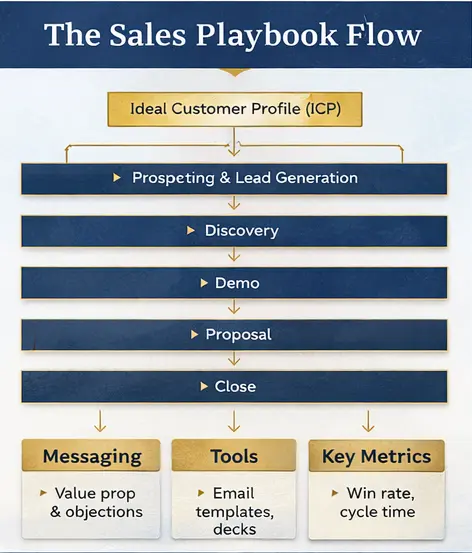
Before anything else, nail down your Ideal Customer Profile (ICP). This isn’t just “companies that could use our product.” It’s specific to industry, company size, revenue range, team structure, and the pain points your solution directly addresses.
Pull data from your CRM. Look at your best customers, the ones who signed quickly, stayed long, and expanded. What do they have in common? That’s your ICP.
Step 2 - Document Your Sales Process Stage by Stage
Map out every stage from first contact to closed deal. For most B2B teams, that looks something like:
- Prospecting and lead generation.
- Discovery and qualification.
- Product demo or solution presentation.
- Proposal and negotiation.
- Closing and handoff to onboarding.
For each stage, define two things: what needs to be true for a deal to enter that stage, and what needs to happen for it to move forward. This kills the habit of reps carrying dead deals indefinitely. Understanding where prospects drop out of the buying journey can help teams improve qualification and follow-up. Read our guide on diagnosing marketing funnel growth problems to identify common bottlenecks affecting conversions.
Step 3 - Build Your Messaging Framework
Your reps shouldn’t have to reinvent the pitch every time. Give them a messaging foundation that covers:
- Your core value proposition – What problem you solve and why it matters now
- Key differentiators – What makes you a better choice than doing nothing or going with a competitor
- Persona-specific pain points – CFO cares about different things than a VP of Sales
Objection responses – For the pushbacks you hear constantly (price, timing, “we already have something”)
Good messaging isn’t a script. It’s a framework reps can make their own while staying on point.
Step 4 - Arm Your Team with the Right Tools
Every asset should be grounded in what is worked, not what sounds good in theory.Your playbook should include a library of ready-to-use assets:
- Cold outreach email sequences and LinkedIn messages.
- Discovery call question guides.
- Demo presentation decks.
- Proposal templates.
- Case studies organised by industry or use case.
- ROI calculators or business case builders.
Every asset should be grounded in what is worked, not what sounds good in theory. Keep these resources organised in a shared location and connect them to the relevant stages of your CRM process. Representatives should be able to find the right discovery questions, demo materials, case studies and proposal templates without searching through multiple systems. Review usage regularly to identify outdated or underused assets.
Step 5 - Define What Good Looks Like with Real Metrics
- Building it alone – Your top reps know things you don’t. Loop them in early.
- Making it too long – If no one reads it, then it is useless.
- Skipping the data – It should be based on deal intelligence from your CRM, not your gut.
- Treating it as final – The market changes, the way the buyer behaves changes, and the products change. So should the playbook.
For B2B SaaS sales, messaging should reflect the concerns of different decision-makers. A technical buyer may want to understand integrations and implementation, while a business leader may focus on operational impact, cost and expected value. Document relevant talking points for each persona, but allow representatives to adapt the conversation to the prospect’s situation.
When sales processes, CRM data and performance metrics are aligned, managers can make more informed decisions across the revenue cycle. Explore how revenue operations can improve alignment across sales processes and revenue performance.
A playbook without measurement is just a document people read once and forget. Tie your playbook to real KPIs:
- Lead response time.
- Discovery-to-demo conversion rate.
- Average sales cycle length.
- Win rate by stage, persona, and deal size.
When reps know what benchmarks to aim for, they have a clear target. And when managers review performance, they know exactly where to coach. Review these metrics together rather than treating them as isolated numbers. For example, a high number of demos may not indicate healthy pipeline performance if few prospects progress to proposals. Compare conversion rates between stages, examine performance by customer segment and use the findings to identify where coaching or process changes are needed. Set benchmarks using your own historical performance rather than assuming one target applies to every SaaS business. When sales processes, CRM data and performance metrics are aligned, managers can make more informed decisions across the revenue cycle. Explore how revenue operations can improve alignment across sales processes and revenue performance.
Step 6 - Keep It Alive
This is where most playbooks fail. They get built, celebrated, and then ignored six months later because nobody updated them.
Set a quarterly review, assess what’s working, retire what isn’t, and add new content based on recent wins and losses. Assign someone ownership of the playbook. Without an owner, it goes stale.
For every stage, document the entry criteria, key sales activities, required information and exit conditions. For example, a prospect should move from discovery to demo only after the representative understands the business problem, relevant stakeholders and intended use case. Clear stage definitions help the team maintain accurate pipeline records and avoid advancing deals without sufficient qualification.
The Bottom Line
A repeatable B2B sales playbook is more than just helping your sales teams close more deals today. It is the foundation on which future growth can be achieved without breaking the sales system every time you try to scale.
It is one of the highest leverage activities a sales leader can invest their time in.
Start with where you are today and make your best attempt at documenting the current best way of doing things. Then iterate from there.
A repeatable sales playbook gives your team a clearer process for managing prospects, improving sales execution and measuring performance. But maintaining consistency as your business grows also requires alignment between sales activities, processes and revenue goals.
If your team needs help building a more structured revenue process, explore Rapid Neuron’s Revenue Operations services to understand how better alignment can support predictable business growth.
Get Growth Diagnosis
Find out what is holding your growth back and how to fix it.