
PLG SaaS Case Study: How Archio 2x’d Free-to-Paid Conversion
Sometime in the third quarter, the team at Archio stopped celebrating signups.
Not because signups had slowed. The product was growing, word of mouth was working, and the free tier was filling up with exactly the kind of users they’d built it for: project managers, operations leads, small team leads inside mid-market companies who’d found the tool through a colleague or a Reddit thread and signed up the same day.
The problem was what happened after that.
Three weeks in, most of them were gone. No cancellation email, no angry feedback ticket. They just stopped coming back. And the ones who stayed active were using the product regularly, clearly getting value from it, and paying nothing.
Free-to-play conversion was sitting at 3.2%. The industry benchmark for a B2B SaaS product at their stage runs between 5% and 8%. They were below the floor, and the gap had been there long enough that the team had started treating it as a fixed constraint rather than a solvable problem.
It wasn’t.
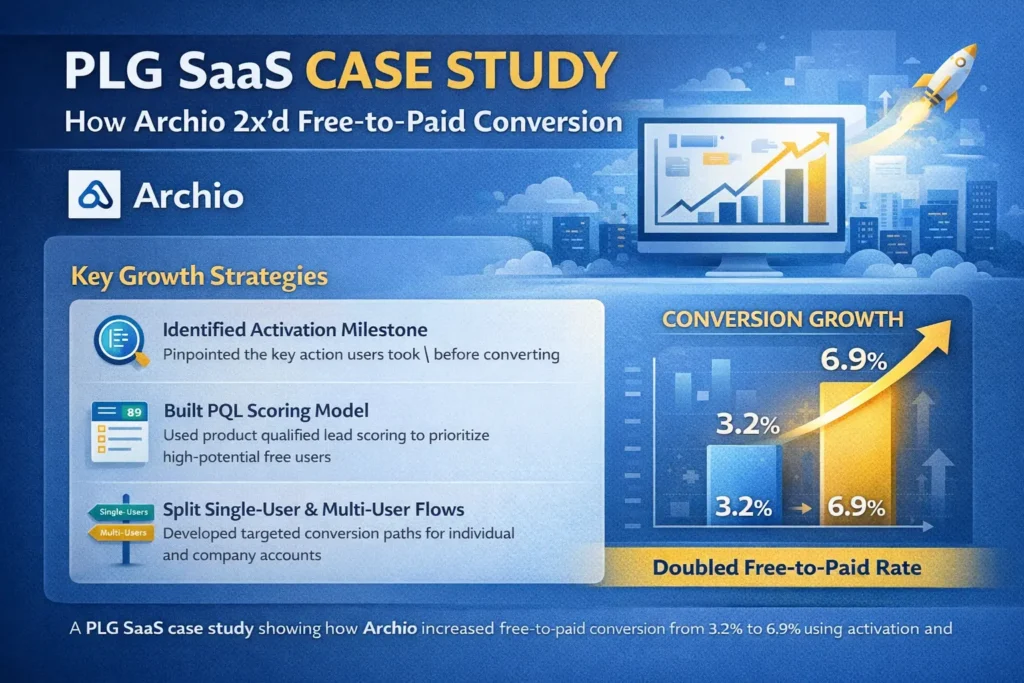
By the end of the following quarter, conversion had reached 6.9%. This PLG SaaS case study covers what they changed, in what order, and why each decision was made.
Why Free-to-Paid Conversion Was Stuck at 3.2%
Archio is a project documentation tool built for operations and project management teams. Structured templates, process libraries, version control for internal documentation, and a search layer that actually works across everything a team has built.
At the point this case study begins, Archio had roughly 4,200 active free users and 134 paying customers. For every paying customer, there were 31 free users. Some of those were genuinely casual, individuals exploring the tool with no buying intent. But a meaningful chunk were active, engaged, and using the product in ways that looked exactly like paying customers, except for the payment.
The question was why.
What the Data Revealed About User Behavior
The first instinct was the pricing page. It almost always is. The team had been through two redesigns in eighteen months, and conversion hadn’t moved meaningfully after either one.
What the actual diagnosis found was more fundamental.
The product had no defined activation milestone. Onboarding pushed users through a setup checklist, created a workspace, uploaded a document, invited a teammate, and then left them to figure out the rest. Checklist completion rates were reasonable.
Retention after completion was not. Users were finishing setup and not coming back, which meant the checklist was delivering the appearance of progress, not actual value.
When the team went back through the usage data of their 134 paying customers and looked for the event that almost all of them had in common before converting, it wasn’t workspace creation. It wasn’t even a document upload.
It was the first time a user ran a cross-document search and got results. Someone typed something into the search bar, pulled up three related documents they hadn’t thought to connect, and understood what the tool was actually for.
Most free users never reach that moment.
The second thing the diagnosis found was a complete absence of any commercial layer underneath the free tier. A pricing page existed. An upgrade button existed.
Nothing in between, no way of identifying which free users were approaching conversion readiness, no logic for deciding when a human conversation might help, no one watching for the accounts where multiple users from the same company had started showing up.
Seventeen free accounts had three or more users active from the same company domain. None of them had been contacted. Nobody had noticed.
Finding the Real Activation Moment
Building a Product Qualified Lead (PQL) Model
The checklist got scrapped. The new onboarding had one job: get users to run a cross-document search within their first session.
Every step in the flow pointed toward that moment. The template library came pre-populated with three connected documents, so new users had something to search across immediately. The empty state copy was rewritten around the search experience rather than the setup process. The first onboarding email, sent two hours after signup, skipped the feature tour entirely and asked one question: Have you tried searching across your documents yet?
Activation rate, defined as reaching the cross-document search milestone within the first seven days, went from 31% to 58% over six weeks.
Splitting Conversion into Two Growth Lanes
With a real activation milestone in place, the team built a PQL scoring model to identify which free users were approaching conversion readiness.
Three signals drove the score. Depth, how many documents a user had created, how often they returned, and how many search sessions per week. Breadth: how many users from the same company domain were active in the free tier. Velocity, how quickly a user reached the activation milestone after signup, and whether usage had grown week over week since.
The breadth signal turned out to be the most predictive. Free accounts with three or more active users from the same domain converted at nearly four times the rate of single-user accounts once they received relevant outreach. The multi-seat signal was surfacing buying intent that nothing else in the data was picking up.
Scores are pushed into Salesforce as a native field, updated daily. For the first time, the sales team could open an account record and see exactly where a free account stood in its product journey without opening a separate tool.
Identifying Expansion Signals in Free Users
Every free user who showed any commercial signal was going to the same place, a generic nurture sequence mentioning the paid plan and linking to the pricing page. It converted at around 4%. The team had stopped questioning it.
Two lanes replaced it.
Single-user accounts that hit the activation milestone and showed strong depth signals went into an automated in-product lane. Usage-triggered upgrade prompts at natural friction points, when a user hits the document limit on the free tier, when they try to access a paid feature, or when they come back for the fifth consecutive week. Well-timed, contextually relevant prompts that appeared when the moment was right.
Multi-seat accounts, companies with two or more users active in the free tier, went into an SDR-assisted lane. The outreach was specific. Not a generic “I noticed you’ve been trying Archio” email. Something closer to: four people from your team have been using the search feature regularly. Here’s what the team plan would look like for your use case. The rep had the usage data before sending anything.
The SDR lane converted at 22%. The automated lane converted at 8.4%.
Results: How Conversion Increased to 6.9%
The seventeen multi-seat free accounts that had been sitting unnoticed became the first test.
A straightforward rule: any free account with three or more users active from the same domain in the past fourteen days gets flagged for SDR review within 48 hours.
Of the seventeen accounts, eleven were contacted. Seven were converted to paid within three weeks. Two requested a demo and converted the following month. Two didn’t respond.
Nine new paying customers from accounts that had been sitting in the free tier for an average of eleven weeks.
What Actually Drove the Growth
Free-to-play conversion went from 3.2% to 6.9% over one quarter.
Activation rate increased from 31% to 58%. More users reaching the real value moment meant more accounts entering the conversion funnel with enough signal to act on.
The automated in-product lane converted activated single-user accounts at 8.4%, up from roughly 3% on the previous nurture sequence.
The SDR-assisted lane converted multi-seat free accounts at 22%.
Average time from signup to conversion dropped from 47 days to 29 days. Users were reaching the activation milestone faster, the scoring model was identifying readiness earlier, and outreach was going out within 48 hours rather than sitting until the next monthly review.
MRR growth in the quarter was 34%, the strongest quarter in the company’s history to that point.
Key Takeaways for SaaS Companies
Getting the activation milestone right first is what made everything else work. Not because the onboarding rebuild was technically complex, it took three weeks, but because the scoring model is only as good as the event it anchors to.
When activation is defined correctly, the scores actually predict conversion. When it’s defined loosely, the whole system produces noise, and nobody can figure out why conversion isn’t improving.
The multi-seat signal had been sitting in the data the entire time. Seventeen accounts with multiple users from the same company, none of them getting any commercial attention. That’s not a missing data problem. The data was there.
It was an operational problem; nobody had built the logic to surface those accounts and route them to someone who could act on them. Adding that one rule, flag any free account with three or more users from the same domain within 48 hours, produced nine new paying customers in the first month.
The SDR outreach worked because it was specific. A 22% conversion rate on that lane isn’t because human outreach is inherently better than automated sequences. It’s because the rep was referencing real product behaviour before sending anything.
When someone emails you and mentions that four people from your team have been using a specific feature regularly, that email lands differently from a standard trial expiry sequence. The product data made the outreach credible. Credible outreach converts.
What Other SaaS Companies Can Take From This
The tools involved here, a reverse ETL pipeline, a scoring model, and two motion lanes with routing logic, are available to any SaaS company at this stage. What made it work was the sequence.
Find the real activation milestone before building anything else. Run cohort analysis on retained customers. Find the event they all had in common before converting. Confirm churned users didn’t have it. That event is the foundation of everything else that sits.
Build the scoring model against actual conversion history. Weight depth, breadth, and velocity signals based on what the data says predicted conversion. The breadth signal, multi-seat activity from the same company domain, is worth checking separately. It’s the most commonly overlooked indicator in PLG SaaS conversion, and it was the biggest driver of results here.
Create distinct motion lanes. Automated in-product conversion for single-user-activated accounts. Human-assisted outreach for multi-seat accounts showing buying committee signals. The outreach only works if the rep has the product data before sending anything.
Watch for expansion signals inside the free tier every week. Accounts with three or more users from the same domain are the highest-converting segment in most PLG products. Most companies aren’t watching for them at all.
Get the product data into the CRM as live fields. If a rep has to open a separate analytics tool to understand what a free account has been doing, the system will be used inconsistently. The data needs to be on the account record.
That’s the sequence. In Archio’s case, it took one quarter to double conversion. The individual pieces aren’t complicated. Getting them in the right order is what made them work.