
How to Layer RevOps on Top of a Product-Led Motion
Most PLG companies build their revenue operations the same way, after the fact, under pressure, when growth has already stalled, and someone in a board meeting asks why self-serve conversion hasn’t moved in three quarters.
By that point, the problem has usually been running for a while.
The issue isn’t the product. Products that reach meaningful scale through a self-serve motion are, almost by definition, doing something right. The issue is that product-led growth generates an enormous amount of commercial signal, activation milestones, usage spikes, seat expansion, and feature depth, and without the right operational layer sitting underneath it, that signal just disappears. Nobody acts on it. Revenue that should be converting isn’t.
That’s the PLG revenue operations problem. And it’s not a technology problem first. It’s a priority problem.
Why Most PLG Companies Delay Revenue Operations
The teams that built early PLG motions at companies like Figma and Notion were, in many cases, deliberately keeping traditional sales infrastructure away from the product. Not without reason. They’d seen what happens when a full sales layer drops onto a self-serve product, unsolicited calls to users who never asked to speak to anyone, demo requests sent to people who already know the product better than the rep, a buying experience that gets worse precisely at the moment someone is deciding whether to pay.
So they kept it out.
The problem is that “protect the product experience from bad sales behaviour” got treated as the same thing as “don’t build any commercial infrastructure.” It isn’t. One is a principle about how buyers should be treated. The other is a decision to leave revenue unattended.
Companies where PLG revenue operations work well understand this distinction clearly. They’re not trying to make the self-serve motion more sales-heavy. They’re trying to make the commercial layer intelligent enough that when a human does get involved, it’s at the right moment, with the right context, in a way that’s actually useful to the person on the other end.
PLG Revenue Operations Framework: What You Need to Build
Underneath the terminology, PLG revenue operations answers three operational questions, and most companies can only answer one of them.
Who in your free user base is ready to convert right now? Who inside a paying account is expanding fast enough that they’re about to outgrow their current plan? And who activated six weeks ago, went quiet, and hasn’t come back, and why?
The first question gets most of the attention. The second and third are where the revenue actually is.
Expansion revenue – seat growth, tier upgrades, and cross-sells account for between 40% and 70% of net new ARR at most mature PLG companies. That number tends to surprise people the first time they see it broken out. The self-serve acquisition motion gets all the credit, but it’s the expansion engine that determines whether the business compounds.
And the third question, the re-engagement signal, is where most PLG companies have essentially no operational answer at all. Users who activated and stalled are telling you something specific about where the product experience breaks down. In most cases, that information sits in a product analytics tool and never reaches anyone who can do something with it commercially.
The infrastructure that answers all three questions requires three things to be true simultaneously. Product event data has to flow into the CRM as live fields that reps can see without logging into a separate tool. There has to be a scoring model that weights behavioural signals, how deep into the product someone is, how many seats are active, how quickly they reached key milestones, rather than relying primarily on firmographic data like company size. And there has to be routing logic that decides, for every account crossing a threshold, which motion is appropriate, automated in-product, SDR-assisted, or AE-led.
Tools like Census or Hightouch handle the data pipeline. The scoring model gets built from your own conversion history. The routing logic requires someone to make deliberate decisions about what each motion lane looks like and who owns it.
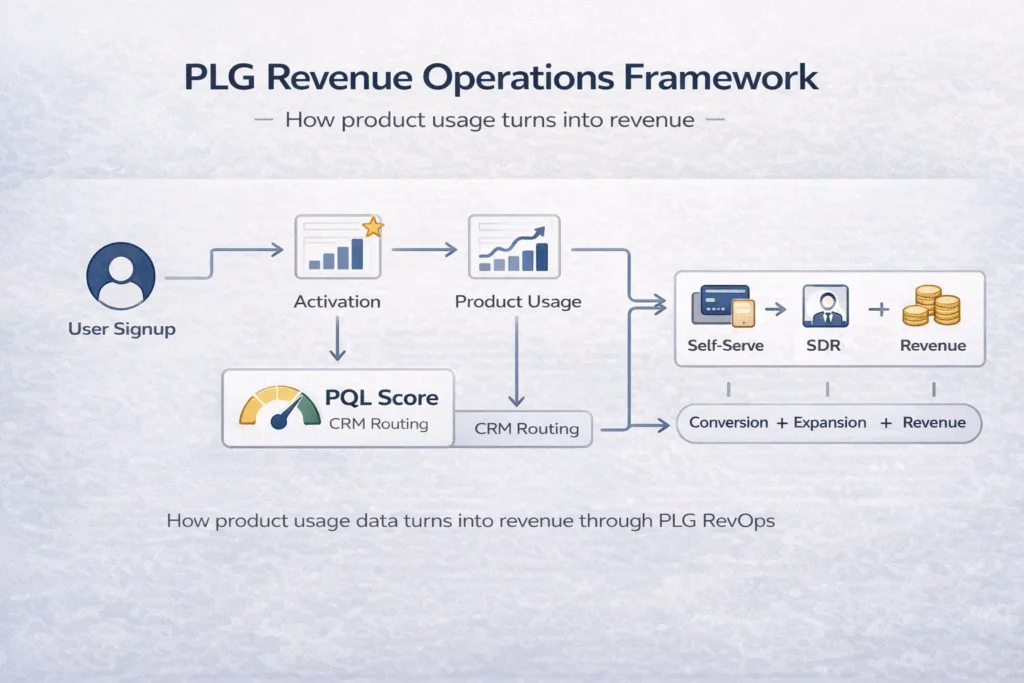
Step 1: Identify Activation Milestones That Predict Retention
Everything downstream in PLG revenue operations depends on this being right, and it’s wrong more often than people admit.
Activation is not completing an onboarding checklist. It’s not logging in three times in the first week. It’s the specific moment when a user has done the thing your product exists to help them do, and experienced enough value from it that the probability of them coming back is materially higher than it was before.
Finding that moment requires looking at cohorts of users who became long-term retained customers and identifying the event they all had in common within the first few days. Then, looking at churned users and confirming that most of them didn’t have it. The event that most cleanly separates the two groups is the activation milestone.
This is worth spending real time on. A scoring model built on the wrong activation event produces scores that don’t predict conversion. The whole system underperforms, and it’s not obvious why.
Step 2: Build a Product Qualified Lead (PQL) Scoring Model
A Product Qualified Lead is not just an activated user. Activation is a floor. The score is built on what happens after.
Three signal types matter most. Depth – how many features has this user engaged with, and how regularly? Breadth – how many people from the same company are active in the product? Velocity – how quickly did they reach key milestones after signup?
Each one tells you something different. Depth tells you about an individual’s commitment to the tool. Breadth tells you whether the product has spread inside the organisation, which means someone internally is advocating for it, that’s a buying signal, not just a usage signal. Velocity tells you about urgency, which matters for timing.
Run these signals against your historical conversion data. Let the data weigh them. Most teams, when they do this properly, find that the multi-seat signal, multiple people from the same company active in the free tier, outpredicts firmographic fit by a significant margin for mid-market accounts. Company size and industry are useful for qualifying accounts. They’re weak at predicting which ones are about to convert.
Step 3: Create PLG Revenue Motion Lanes (Self-Serve, SDR, AE)
The most consistent mistake in PLG revenue operations is treating all product-qualified accounts as if they need the same response.
A two-person team that activated last week and is using the product casually needs automated in-product conversion, better pricing page experience, a well-timed upgrade prompt, and maybe an email. Human involvement here tends to interrupt rather than help.
A company where eight people across two departments have been using the free tier for five weeks, three of them have invited external collaborators, and usage has increased every week; that account has AE conversation written all over it. But not a generic discovery call. A conversation where the rep comes in knowing exactly what those eight people have been doing in the product, which features got traction, and where the friction points are. That context is what makes the call worth taking.
Between those two is the middle lane, accounts that have crossed a score threshold but aren’t yet showing the team expansion signal. Short, informed SDR outreach. Not prospecting. Reference specific product behaviour, offer to help with something concrete, and keep it brief.
Each lane needs its own SLA, its own success metrics, and its own rules about what reps are and aren’t allowed to do. Particularly that last one.
Step 4: Sync Product Data with CRM for Sales Visibility
This is the part that most implementations skip and then wonder why reps aren’t using the system.
If a rep has to open Amplitude, find the account, pull the relevant events, and then manually update Salesforce before making a call, they won’t do it every time. They’ll do it for the accounts they were already planning to call, which mostly defeats the purpose.
The PQL score, the activation status, the last meaningful product event with a timestamp, the number of active seats, the usage relative to plan limits, these should be on the account record in the CRM, updated automatically, visible the moment the rep opens the account. The conversation starts there.
Reverse ETL tools like Census and High touch exist specifically to make this happen without engineering work that takes six months to scope and deprioritise.
Step 5: Define Sales Engagement Rules in PLG
Outreach in a PLG motion fails most often not because reps are bad at their jobs, but because the system puts them in contact with the wrong people at the wrong time, with not enough context to make the conversation useful.
The rules of engagement need to be explicit. What score threshold triggers SDR outreach? Which channel, email first, not phone. What information does the rep must have before making contact? And what they don’t do, pushing for a demo call with someone who’s been actively self-discovering the product is almost always wrong. Offering to help with a specific thing the usage data shows they’ve been struggling with is almost always right.
The intent is simple: when a human steps into the product-led motion, it should feel like an upgrade to the experience. If it feels like an interruption, the rules aren’t tight enough.
Step 6: Build a PLG Expansion Revenue Engine
Expansion is where the compounding happens, and most PLG companies treat it as something to figure out after the acquisition motion is running well. That’s the wrong sequence.
The expansion triggers are mostly usage-based. Someone is getting value, they’re approaching the limits of their current plan, and there’s a natural moment to move them up. The RevOps layer catches that moment, at 80% of tier limits, not after they’ve already hit the ceiling and gotten frustrated.
CS-to-sales handoffs for accounts showing buying committee formation. Win-back sequences for accounts that downgraded, in PLG, a lot of churn is situational rather than a product rejection, and a well-timed re-engagement six weeks later converts at a higher rate than most teams expect.
Why Product and Sales Misalignment Breaks PLG RevOps
RevOps in a PLG motion requires product and sales to share ownership of the conversion funnel. Most organisations aren’t set up for that, and the resistance is real on both sides.
Sales teams trained in outbound prospecting struggle with product-signal-driven outreach because it requires preparation they’re not used to. You can’t open with a generic discovery question when the person you’re calling has been living in your product. They know things about it you don’t. The only way that call goes well is if the rep comes in genuinely knowing what the account has done, what they haven’t done, and what that tells them about where to take the conversation.
That requires product fluency. Every rep working PQLs should be a genuine power user of the product. Not a demo-trained rep who knows the pitch. Someone who uses it regularly enough to have an opinion about it.
On the product side, the concern usually sounds like protecting the self-serve experience from sales contamination. It’s a legitimate concern. But the answer is tight rules of engagement, not separation. Product and RevOps should co-own the funnel from activation through paid. When they don’t, the gaps show up in the conversion rate, and nobody quite owns the problem.
The metric that forces shared accountability: PQL-to-paid conversion rate broken out by activation cohort. It makes the product responsible for the quality of users they activate, not just the volume. It makes sales responsible for working the right accounts, not just the easiest ones.
Key Metrics to Track in PLG Revenue Operations
Signup-to-activation rate. This is the health check for the top of the funnel. If a high percentage of signups never reach the activation milestone, the RevOps work downstream won’t compensate for it. Fix the activation rate first.
PQL volume and score distribution week over week. Healthy PLG revenue operations produce a consistent PQL flow. Erratic volume usually means an upstream activation problem or a scoring model that needs recalibration.
Time-to-touch on PQLs. The window for a meaningful conversation with a high-intent free user is real, and it closes. Teams that respond within 24 hours of a threshold being crossed consistently outperform teams that batch their PQL outreach.
Self-serve conversion rate versus assisted conversion rate, tracked separately. You want to know the actual incremental lift the RevOps motion is adding over what the product would have converted on its own. Without that separation, sales gets credit for conversions that were happening anyway.
Net revenue retention. This is the number that tells you whether the whole system is working. Above 120% means the expansion engine is running. Below 100% means contraction and churn are outpacing expansion, which is a structural problem that more acquisitions won’t fix.
How to Start Building PLG Revenue Operations
The instinct is to build everything at once. Score the PQLs, fix the data pipeline, stand up the three motion lanes, build the expansion plays, all in Q1. That’s how you get a half-built system that nobody trusts because nothing in it is working well enough to rely on.
Get the activation milestone right first. Then build the scoring model against your actual conversion history. Then fix the data pipeline, so scores are visible in the CRM. Only once those three things are running should you start building the motion lanes.
The infrastructure has to exist before the plays make any sense. And the scoring model is only as good as the activation milestone it’s anchored to.
Get those in the right order, and the rest is more straightforward than it looks from the beginning.