When to Hire Your First SDR vs. Let RevOps Handle Outbound
At some point, every B2B company faces the same question:
Should we hire an SDR, or let RevOps handle outbound? Someone brings up hiring SDRs in a pipeline review, and the room nods, but three weeks later, nothing has moved because nobody quite agreed on whether that’s actually the right call yet.
This is that decision, worked through properly.
The SDR vs RevOps outbound question isn’t really about which one is better. It’s about which one is right for where you are today, and getting that wrong in either direction costs you more than just money.
SDR vs RevOps Outbound: What Each Option Means
Bringing in an SDR is a statement about where your business is. You’re saying the ICP is solid, the messaging has been tested, and the constraint is human capacity to generate more conversations. The SDR’s job is to execute a motion that already works, at a higher volume.
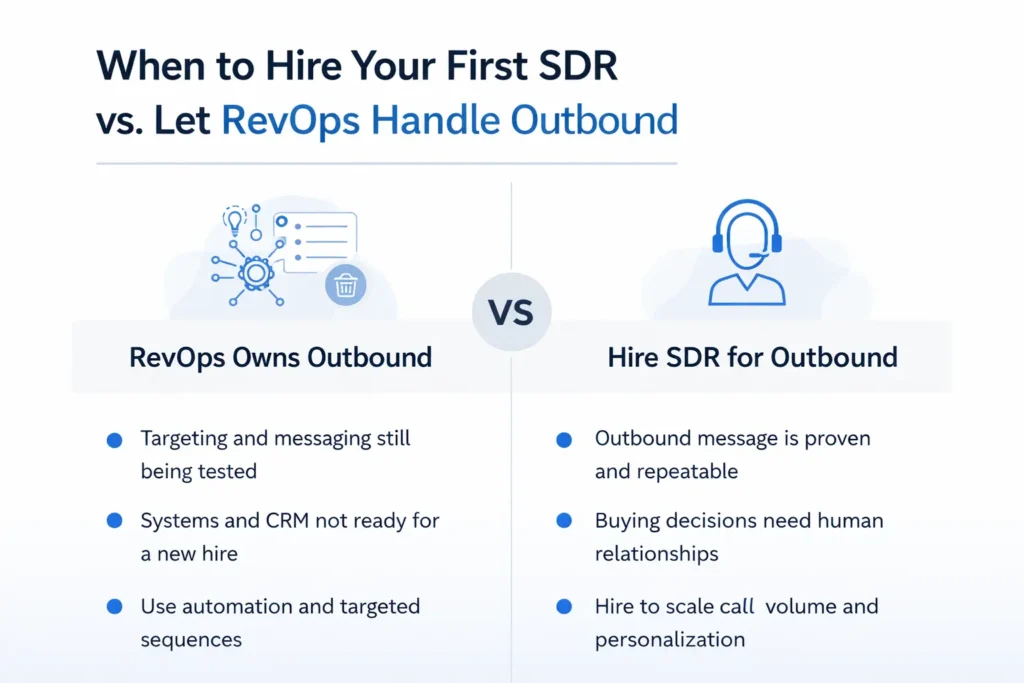
RevOps owning outbound is a different statement entirely. You’re saying the motion isn’t proven yet, or the infrastructure isn’t ready to hand to someone new, and you need the system to do the learning before you hire the headcount. That’s not a fallback position. For a lot of companies at the right stage, it’s the smarter bet.
The problem is that most hiring decisions happen under pipeline pressure, not strategic clarity. And “we need more pipeline” is not a sufficient reason to hire an SDR. It might be a reason to fix your sequences. It might be a reason to tighten your ICP. It might be a reason to audit why your current outbound isn’t converting. Or it might genuinely be a headcount problem. The only way to know which one you’re dealing with is to look at the evidence before you post the job description.
When RevOps Should Handle Outbound Instead of Hiring SDRs
Your ICP has moved in the last six months. This one matters more than people give it credit for. An SDR hired into an unclear ICP will burn their time and their confidence on targets that were never going to close. You’ll generate six months of misleading data, lose a decent hire, and end up back at square one with a more cynical view of SDRs than you started with. RevOps building tighter targeting criteria costs a fraction of that experiment.
Your sequences are running on gut feel. Someone set them up because they seemed reasonable. You don’t know whether the subject lines are doing any work, whether the call step is worth including, or whether the LinkedIn touches add anything measurable. RevOps-led outbound with intentional testing answers those questions cheaply. An SDR learning the same things through trial and error is one of the more expensive ways to run that experiment.
Your CRM isn’t in a state you’d hand to a new hire. Dirty territory data, incomplete firmographics, no clear handoff process between marketing and sales, these don’t just slow SDRs down, they demoralise them. If you wouldn’t be confident sitting a new person down at your CRM on their first day, that’s a RevOps problem that comes before a hiring decision.
Your ACV doesn’t support the fully-loaded cost. Somewhere below $15k–$20k ACV, the unit economics of a dedicated SDR get genuinely uncomfortable. RevOps-led automation and targeted sequences can often produce the volume you need at a cost profile that works, without the management overhead that a new SDR requires to succeed.
When to Hire Your First SDR
Personalisation at this level requires a human. There are buying committees, deal sizes, and enterprise accounts where a well-crafted sequence is simply not the right tool. When your target contacts are senior enough, relationship-driven enough, or complex enough that a sequence won’t move them, you need someone making those calls and building those relationships. Automation doesn’t replace that. It just exposes the gap faster.
You have a repeatable message and evidence that it works. You’ve run enough outbound manually, through RevOps, or through an agency, that you know what gets replies, what opens conversations, and roughly what the objection landscape looks like. An SDR hired into that environment has a real footing from day one. Without it, they’re essentially running your GTM discovery at sales rep rates.
Volume is now the actual constraint. RevOps-led outbound is efficient, but it has a ceiling. When your quarterly pipeline target requires more top-of-funnel activity than your current motion can produce, and you’ve ruled out that it’s a conversion problem rather than a volume problem, adding human capacity makes sense. At that point, the question becomes whether you start with one SDR or two, not whether the hire is justified.
You have the management bandwidth. This one gets glossed over constantly. An SDR without a manager who’s reviewing calls, coaching messaging, running weekly 1:1s, and keeping them accountable to leading indicators will drift, usually within sixty days. The talent isn’t the risk. The absence of real management attention is. If you’re the founder or VP of Sales planning to manage an SDR while running a full quota and handling everything else on your plate, be honest with yourself about whether that time is genuinely available.
Common SDR vs RevOps Mistake in Outbound Strategy
The most common failure in this decision isn’t picking the wrong option. It’s running both at once without clear ownership.
RevOps builds sequences. Marketing sends campaigns. Someone hires an SDR because the board asked about the pipeline. Now, three things are happening: nobody owns the outbound strategy, and none of the three has enough volume to draw real conclusions from. Nine months later pipeline hasn’t moved, and the post-mortem is inconclusive because there were too many variables running simultaneously.
Clean outbound motions have one owner. Early stage, that’s RevOps. The job is to prove what works. Once the motion is producing qualified conversations consistently and the bottleneck shifts from “we don’t know what works” to “we need more of what works,” that’s when the transition to a dedicated sales development function makes sense, with RevOps continuing to own the infrastructure so SDRs are spending their time on conversations rather than list building and admin.
SDR Hiring Checklist: 4 Questions to Answer First
Can you describe in one sentence what your SDR will say to get a meeting — and do you have data showing that message works? If the answer isn’t immediate and specific, the motion isn’t ready.
Do you know the three firmographic or behavioural signals that most reliably predict a deal closing? If you’re uncertain, there’s targeting work to do before an SDR can be genuinely effective.
Is your pipeline shortfall a volume problem or a conversion problem? Volume problems need people. Conversion problems need a process. Hiring an SDR to patch a conversion problem is expensive and demoralising for the SDR.
Do you have eight hours a week available for real SDR management through the first ninety days? Not periodic check-ins, structured coaching, call review, and pipeline inspection. If that time isn’t there, push the timeline until it is.
Four clear answers that hold up mean you’re ready. Anything that gives you pause means RevOps should own the next chapter of your outbound motion. That’s not a consolation prize; a well-run RevOps-led outbound at the right stage produces better pipeline quality than an under-supported SDR at almost any stage.
Final Thoughts on SDR vs RevOps Outbound Strategy
The companies that build durable outbound engines don’t treat this as a permanent choice. They use RevOps to prove the motion and SDRs to scale it. The mistake is collapsing that sequence, either by hiring too early before the motion is understood, or waiting so long for perfect readiness that a pipeline window closes.
If you’re unsure whether your outbound problem is a volume issue or a messaging issue, that’s exactly where most teams lose months.
Getting clarity early saves both pipeline and hiring mistakes.
Talk to Rapid Neuron about your outbound motion