
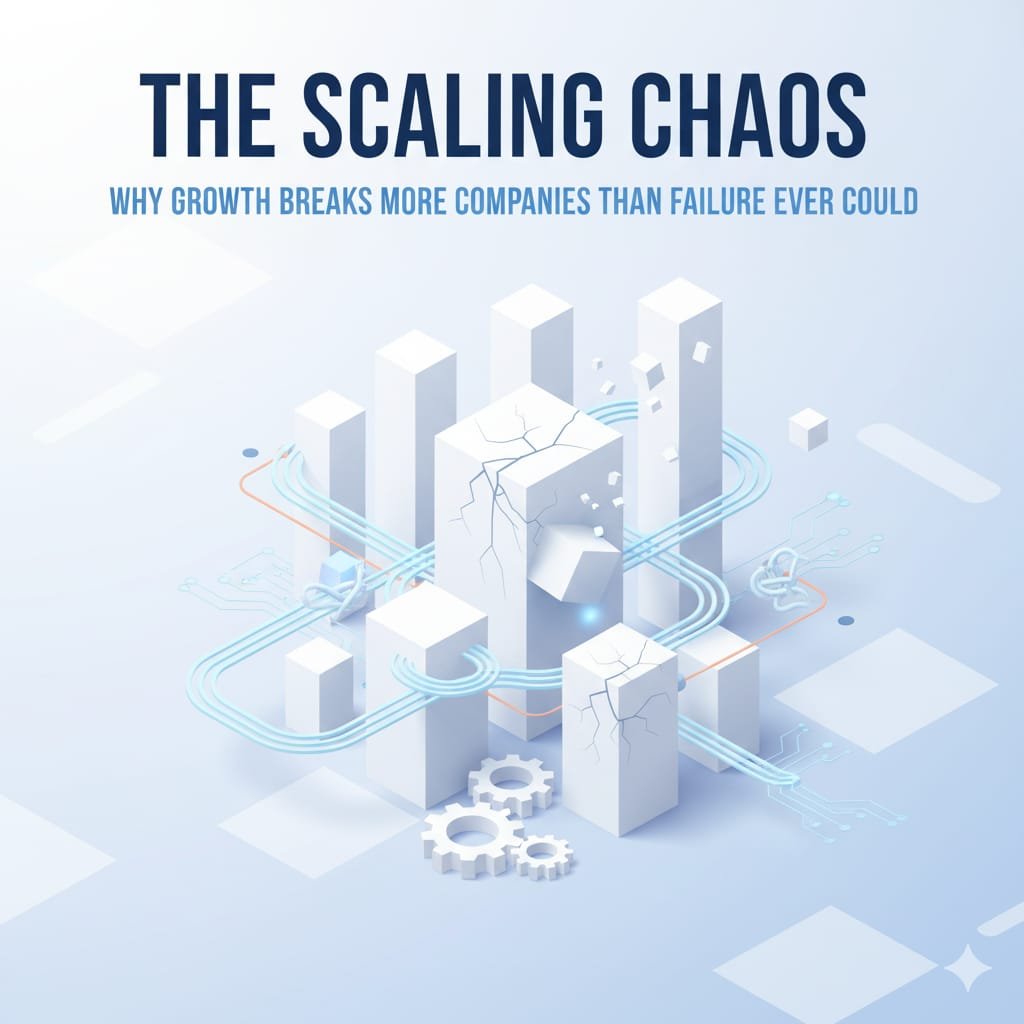
The Scaling Chaos: Why Growth Breaks More Companies Than Failure Ever Could.
Growth is exciting until it isn’t.
At first, it feels like everything is working.
Customers are signing up, revenue graphs are trending up, investors are paying attention.
Then suddenly, things start breaking.
Deadlines slip. Communication slows. Quality drops.
The strange truth?
Most companies don’t fail because they couldn’t grow.
They fail because they grew too fast, too chaotically.
The Hidden Truth About Scaling
Scaling magnifies everything the good, the bad, and the broken.
Every weak process, unclear role, or unspoken expectation that was manageable at 10 people becomes destructive at 50.
It’s not that the company changed it’s that complexity multiplied faster than clarity.
What worked when everyone was in the same room no longer works when teams are spread across time zones and functions.
What Scaling Chaos Looks Like
You’ll know you’re in it when:
Projects take longer despite more hands.
You hire faster but still feel understaffed.
Leaders spend more time in meetings than making progress.
Customer satisfaction drops even as your reach grows.
In short the company gets bigger, but not better.
Why It Happens
Most founders focus on growth as an outcome, not scalability as a design.
They add people before they add process.
They chase speed before structure.
And eventually, the company becomes a tangle of overlapping responsibilities, unclear communication, and reactive firefighting.
It’s not incompetence it’s human nature.
We assume what worked before will keep working, until it doesn’t.
The Real Solution: Build Systems Before Scale
The companies that scale successfully do something counterintuitive they slow down before speeding up.
They build internal scaffolding:
Clear decision rights (who decides what and when)
Documented processes that are simple but repeatable
Internal rhythms weekly huddles, metrics reviews, retrospectives
When done right, these systems don’t create bureaucracy they create freedom.
Freedom from chaos. Freedom from confusion. Freedom from redoing the same mistakes every quarter.
The Founder’s Role During Scaling
As a founder, your job shifts from being the driver to being the designer.
You stop steering every move and start designing the engine itself.
That means creating a culture where systems evolve with the company not against it.
Because scaling isn’t about adding speed it’s about building endurance.
Final Thought
When growth feels like chaos, it’s not a “people problem” it’s a design problem.
The best leaders don’t just manage scale; they architect it.