PLG vs Sales-Led Growth – Which Motion Actually Fits Your Stage?
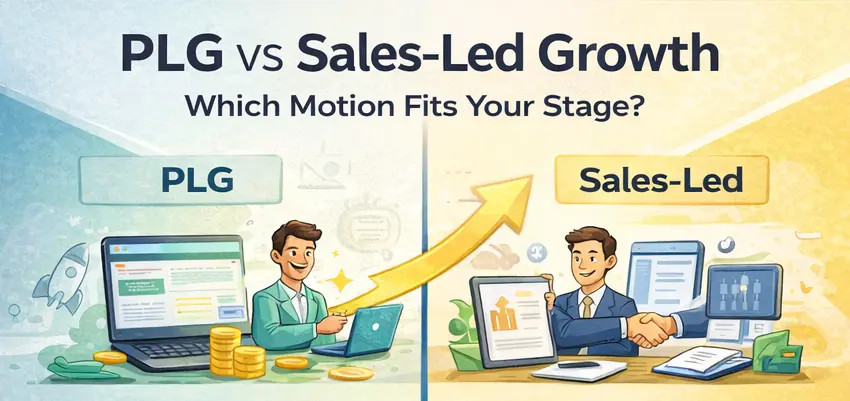
At some point, almost every founder building a B2B product faces the same question: Should we let the product sell itself, or should we build a sales team to drive growth?
It sounds like a strategic choice. And it is. But for most early-stage businesses, it’s also a question that gets answered by default rather than by design, and the wrong default costs months of runway and significant revenue.
PLG vs sales-led growth isn’t a debate about which model is better in theory. It’s a practical question about which motion fits where your business is right now, and where it needs to go next.
What PLG Actually Means - And What It Doesn't
Product-led growth is a go-to-market motion where the product itself drives acquisition, conversion, and expansion. Users discover the product, try it without friction, experience value quickly, and upgrade or expand based on that experience. Sales and marketing support the motion, but the product does the heavy lifting.
The businesses most people associate with PLG, Slack, Notion, Figma, and Calendly share a specific set of characteristics. The product is intuitive enough to be adopted without a demo. The value is felt within minutes of signing up. And the natural usage pattern creates a reason to invite others or upgrade.
What PLG is not is a strategy for every product at every stage. The freemium model, the self-serve checkout, and the viral loop only work when the product is genuinely ready to sell itself. Launching PLG with a product that requires explanation, configuration, or onboarding support is not a growth strategy. It’s a leaky funnel with a free tier attached.
What Sales-Led Growth Actually Means
Sales-led growth is a go-to-market motion where a human-driven sales process drives acquisition and revenue. Marketing generates awareness and demand. Sales converts that demand into customers through direct engagement, discovery calls, demos, proposals, negotiations, and relationship management.
Sales-led growth works across a broad range of product types, including complex solutions, high-value contracts, and products that require customisation or integration before value is realised. The sales cycle is longer, the cost of acquisition is higher, but the average contract value and the ability to sell into specific accounts make the model economically viable at the right price point.
What sales-led growth is not is an admission that the product isn’t good enough. Some of the fastest-growing B2B companies in the world are sales-led because their product requires context, trust, and relationship to sell effectively. That’s not a product failure. That’s a market reality.
“Sales-led growth is not an admission that the product isn’t good enough. That’s not a product failure. That’s a market reality.” – Rapid Neuron
The Honest Comparison - Where Each Motion Wins and Where It Doesn't
Factor | PLG | Sales-Led Growth |
Best for | Simple intuitive products | Complex high-value solutions |
Average contract value | Lower – self-serve pricing | Higher – negotiated contracts |
Sales cycle | Short – days to weeks | Longer – weeks to months |
Cost of acquisition | Lower at scale | Higher – requires sales headcount |
Time to value | Immediate – product proves itself | Delayed – requires onboarding |
Ideal buyer | Individual users or small teams | Enterprise or mid-market buyers |
Scalability | High – scales without headcount | Moderate – scales with headcount |
Required product maturity | High – must work without support | Moderate – sales bridges the gaps |
When PLG Is the Right Motion
PLG makes sense when three conditions are true simultaneously.
The product delivers value without explanation. If a new user can sign up, reach the core value of the product, and understand why it matters, without a demo, a call, or an onboarding session, PLG is viable. If they can’t, PLG will generate signups and churn, not signups and conversion.
The price point supports self-serve conversion. Products priced below a threshold where buyers will comfortably enter a credit card without speaking to anyone, typically under AED 1,000 to AED 2,000 per month for most markets, are natural candidates for PLG. Above that threshold, buyers want conversation before commitment.
There is a natural viral or expansion loop. PLG compounds when usage naturally leads to more usage, inviting teammates, sharing outputs, or expanding seats. Without that loop, PLG can acquire users but struggles to grow revenue from them.
When Sales-Led Growth Is the Right Motion
Sales-led growth makes sense when the product requires context to sell, when the buyer is a committee rather than an individual, or when the contract value justifies the cost of a sales process.
Complex products that require integration, configuration, or workflow change don’t sell themselves. A buyer evaluating a platform that will touch their finance system, their customer data, or their operational processes wants to speak to someone who understands their specific situation before signing a contract.
Enterprise and mid-market buyers rarely make purchasing decisions without human engagement. Procurement processes, security reviews, legal negotiations, and multi-stakeholder sign-offs are standard. A self-serve checkout doesn’t work in that environment, regardless of how good the product is.
High-value contracts justify the investment in a sales motion. When average contract values are significant, the economics of a dedicated sales team make sense, even if the cost of acquisition is higher than a PLG model would produce.
The Hybrid Approach - When Both Motions Run Together
The most sophisticated B2B companies don’t choose between PLG and sales-led growth. They use both, and the sequence matters.
PLG at the bottom, sales-led at the top. A freemium or free trial tier drives individual adoption and creates product usage data. Sales uses that data to identify accounts with high engagement and converts them into enterprise contracts. The product opens the door. Sales closes the deal.
This model, sometimes called product-led sales, works when the product has enough self-serve adoption to generate pipeline, and when the sales team has enough intelligence from that adoption to have highly relevant, highly contextual conversations with buyers who are already using the product.
It requires both motions to be working well independently before they can be combined effectively. Trying to run a hybrid model with an immature product or an undertrained sales team produces the worst of both worlds rather than the best.
How to Decide - The Right Question to Ask
The right question isn’t PLG or sales-led. It’s where the value is first felt in my product, and who needs to be involved in the buying decision?
If value is felt immediately by the individual user and the buyer is that same individual, PLG is likely the right starting point. If value requires configuration and the buyer is a team, a department, or a committee, sales-led growth is the right foundation.
Most early-stage B2B businesses that are honest about where they are start sales-led, use that process to deeply understand their buyers, and introduce PLG elements once the product is mature enough and the customer profile is clear enough to support self-serve adoption.
This Is the Decision Rapid Neuron Helps Founders Get Right
Choosing the wrong growth motion at the wrong stage doesn’t just slow a business down. It burns budget, demoralises teams, and creates confusion in the market about what the product actually is and who it’s for.
Rapid Neuron works with founders and revenue leaders who are navigating exactly this decision, helping them assess where their product is, where their buyers are, and which motion will produce the most predictable revenue at their current stage.
Not with a framework pulled from a blog post. With a process built around the specific reality of their business.
Talk to the Rapid Neuron team today – [Contact Us]