
What is Product-Led Growth (PLG) and is it Right for your B2B Company?
Growth does not always begin with a sales call. For a growing number of B2B companies, it begins the moment a user signs up, opens the product, and realises it solves exactly what they needed. That is product-led growth, a B2B growth strategy where the product itself brings in, converts, and retains customers without a sales team carrying the full weight of that process. For US B2B companies that get this model right, product-led growth is one of the most capital-efficient paths to revenue that is both predictable and scalable.
The proof is already in the market. Slack, Notion, Figma, and Calendly all achieved substantial B2B growth by enabling users to experience the product well before speaking to a salesperson. These companies share more than just a great product; they have a deliberate, product-led strategy centred on the user experience. However, adopting PLG successfully requires more than just following a trend. It demands an honest evaluation of whether your product, your buyers, and your infrastructure are truly prepared for a product-led growth model.
What Is Product-Led Growth?
Product-led growth is a methodology where the product does the work a sales team would otherwise do, attracting users, proving value, and converting them into paying customers. Rather than guiding B2B prospects through a lengthy sales process before they ever touch the product, a product-led approach flips the sequence entirely. Users get access first, experience value independently, and the revenue decision follows from that experience, often without any human involvement.
In a conventional sales-led model, awareness leads to a sales conversation, which leads to access. In a product-led growth model, access comes first. Everything else, including the decision to pay, flows from what the user discovers when they actually use the product.
The three most common PLG entry models used by B2B companies are freemium (a free version permanently available with paid upgrade options), free trial (full product access for a fixed period before payment), and reverse trial (users start on a paid tier and move to a free plan if they do not convert). Each model suits different B2B products, price points, and buyer behaviours, and choosing the wrong entry model is one of the most common early mistakes in a product-led growth transition.
Key insight: Product-led growth is not just a pricing experiment; it is a comprehensive B2B growth operating model. It requires the product to be intuitive enough to sell itself, onboarding to be seamless enough to deliver value quickly, and a robust data infrastructure to track user activities after signup. Without all three, a free trial becomes a leaky funnel rather than a true PLG motion.
Product-Led Growth vs. Sales-Led Growth: Key Differences
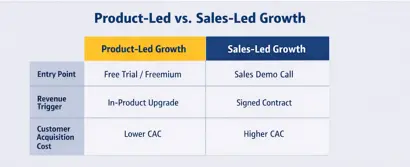
The distinction between product-led growth and sales-led growth is not about which is superior; it is about which fits your B2B product, buyer, and current stage. Here is how the two B2B growth models compare:
Dimension | Product-Led Growth | Sales-Led Growth |
Primary growth driver | The product itself | Sales team outreach |
Entry point | Free trial / freemium | Demo or discovery call |
Revenue trigger | Value experienced first | Contract signed first |
CAC trend | Lower at scale | Tends to rise with scale |
Best fit | Self-serve, lower ACV B2B | Complex, high-ACV B2B |
Many B2B companies today run a hybrid model, using product-led growth for self-serve acquisition while layering a sales team on top for enterprise expansion. This product-led sales motion (PLS) is increasingly common among B2B SaaS companies scaling from $1M to $20M ARR.
How Product-Led Growth Works in Practice
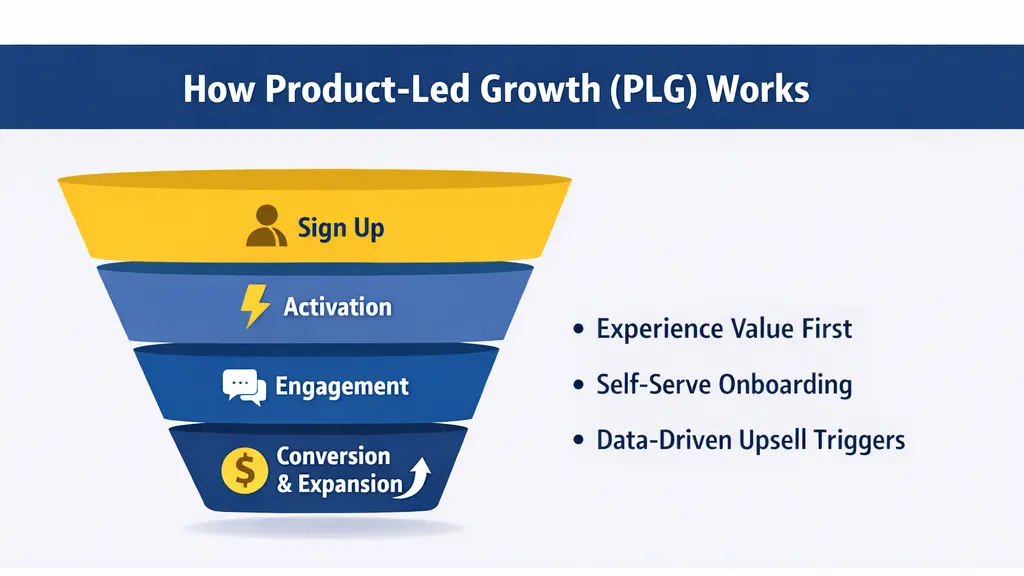
A functioning product-led growth motion runs on four components. Weakness in any one of them undermines the entire B2B growth system.
- Activation – This is the moment a new user first experiences the core value of the product. In PLG, if B2B users do not hit their “aha moment” quickly, typically within the first session, they churn silently and never return. Strong product-led companies design their entire onboarding experience around accelerating this moment.
- Engagement and habit formation – After activation, the product must give B2B users genuine reasons to return. Features that embed into daily workflows, collaborative tools that pull in teammates, and a clear path toward higher-value functionality all build the stickiness that sustains product-led growth long term.
- Conversion triggers – PLG companies use usage data to identify exactly when to prompt a free-to-paid upgrade. The best product-led conversion triggers feel like a natural next step, a storage limit reached, a collaboration feature unlocked, not a wall the B2B user is forced to climb.
- Expansion revenue – This is where product-led growth economics become genuinely powerful for B2B companies. One user who finds value and invites their team creates organic B2B growth with zero sales involvement. Net revenue retention above 120%, where existing customers generate 20% more revenue annually through expansion, is a realistic outcome for well-executed PLG companies.
Is Product-Led Growth Right for Your B2B Company?
Product-led growth is not a universal answer for every B2B business. Use this framework to assess your fit honestly
Lean toward PLG if… | Lean toward Sales-Led if… | |
Your product solves a clear, self-evident B2B problem | Buying involves multiple stakeholders or procurement | |
B2B users experience value within minutes of signing up | Significant onboarding or implementation is required | |
ACV is below $10,000 per year | ACV is above $15,000 per year | |
Your B2B ICP is technical and prefers to self-serve | Your ICP relies on vendor guidance and relationships | |
You have analytics to track product-led activation | Conversion depends heavily on custom demos |
Important: The most common PLG failure we see in B2B companies is forcing a free trial onto a buyer who genuinely needs a guided evaluation. The trial generates signups, but almost no conversions, and the team concludes that product-led growth does not work. In reality, the product and the B2B growth motion were mismatched from the start. PLG is not a fix for a slow sales cycle. It is a fundamentally different motion.
What You Need Before Adopting PLG
Committing to a product-led growth motion requires three things to be in place before the B2B growth benefits materialise:
- A product that delivers standalone value quickly. If meaningful value in your B2B product requires heavy setup or change management, PLG will struggle regardless of how strong the product is.
- Product analytics infrastructure. You cannot optimise a product-led motion without visibility into activation rates, time-to-value, feature adoption, and conversion triggers. For any B2B company serious about PLG, instrumentation is foundational, not optional.
- A self-serve onboarding experience. Most B2B products were not originally built for self-serve. Adopting product-led growth often means fully redesigning the first-user experience, including in-app guidance, contextual prompts, empty states, and progressive feature disclosure.
For most B2B companies, the path to product-led growth is a phased transition, piloting with one segment, measuring activation and conversion closely, and reducing sales-touch dependency as the PLG motion proves itself.
How Rapid Neuron Supports Product-Led Growth for B2B Companies
At Rapid Neuron, our Product-Led Growth service helps US digital-first B2B companies build the full operational infrastructure a product-led motion requires, from ICP validation for self-serve segments and PLG onboarding redesign, to usage-based conversion trigger design and the RevOps integration that connects product-led data directly to your B2B growth revenue system.
We work with B2B companies transitioning from a fully sales-led model and those building product-led growth infrastructure alongside an existing sales motion. The goal is always the same: a B2B growth system where the product generates more revenue, predictably and at scale.
For more on connecting product-led growth to your broader revenue system, read How Growth Suite Consulting Aligns Marketing, Sales, and Revenue and Growth Strategy Consulting: What It Is and When You Actually Need It on the Rapid Neuron blog.