
Sales-Marketing Alignment: Why Misalignment Kills Revenue Predictability
Ask any founder or revenue leader what their biggest growth challenge is, and the answers almost always cluster around the same themes: inconsistent pipeline, unpredictable deal flow, leads that don’t convert, and a sales team that never quite has what it needs to close.
What most of them don’t say, because most of them haven’t connected the dots yet, is that all of those problems share a single root cause.
Sales and marketing aren’t aligned.
Not in a vague cultural sense. In a practical operational sense. The two teams are running different plays, measuring different things, and defining success differently. And the business pays for it in the one currency that matters most, predictable revenue.
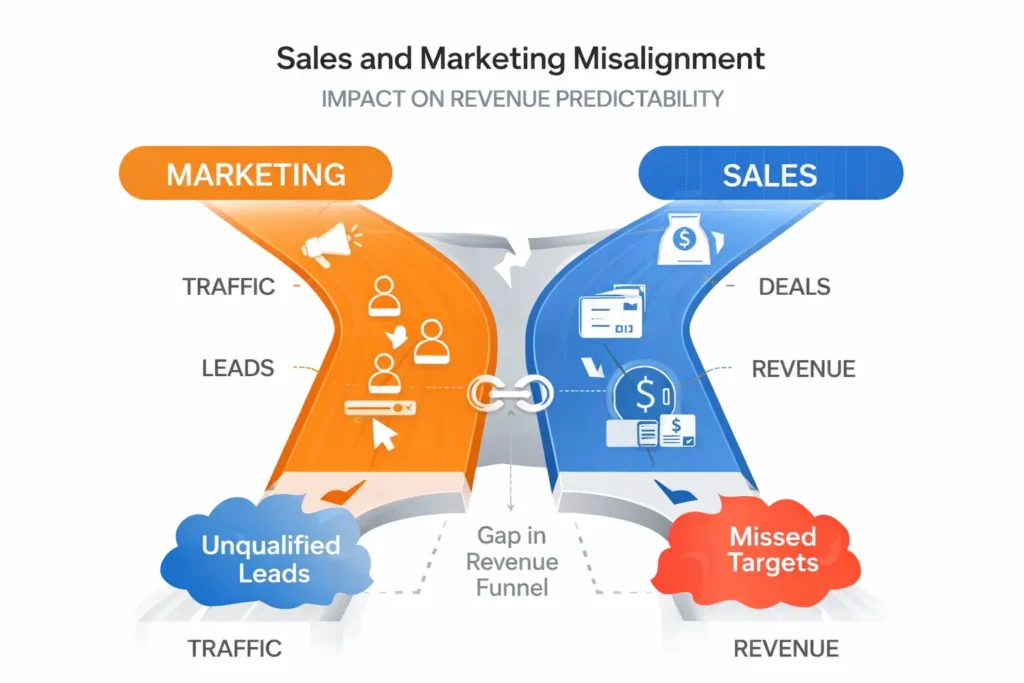
Here’s what that looks like in practice. Marketing celebrates a record month for lead volume. Sales calls those leads unqualified and ignores half of them. Marketing says sales isn’t following up fast enough. Sales says marketing doesn’t understand what a real prospect looks like. Both teams have data to back up their position. Neither team is solving the actual problem.
That dynamic, played out across hundreds of businesses, is not a personality conflict. It is a structural failure with a direct and measurable impact on revenue.
Five Signs Your Sales and Marketing Teams Are Working Against Each Other
Misalignment rarely announces itself clearly. It shows up as a collection of symptoms that each look like isolated problems until you see them together.
Marketing and sales define leads differently. Marketing counts anyone who fills out a form as a lead. Sales counts a lead as someone with a budget, a decision-making role, and an active need. When those definitions don’t match, the handoff between teams becomes a daily source of friction.
The content marketing produced isn’t what sales need. Marketing builds awareness of content. Sales needs case studies, objection handling guides, and ROI calculators. Without a structured conversation between teams about what actually helps close deals, marketing produces what it thinks is useful, and sales builds its own materials from scratch.
There is no agreed lead qualification standard. Without a shared framework defining what a qualified lead looks like, every lead that passes between teams is subject to interpretation. Sales rejects leads without a written standard to justify it. Marketing argues the rejections are unfair. The conversation goes in circles.
It's Not a People Problem. It's a Structure Problem.
Misalignment between sales and marketing doesn’t happen because the people are difficult. It happens because the structures that should connect the two teams either don’t exist or were never properly built.
Separate goals create separate behaviours. Sales are measured by revenue. Marketing is measured by leads and engagement. When teams are optimising for different outcomes, they make different decisions, and those decisions pull in different directions. The misalignment is built into the incentive structure from the start.
No shared language means every handoff is an interpretation. What does a qualified lead mean? What does the ideal customer actually look like? When these definitions exist only in people’s heads and haven’t been agreed upon between teams, every handoff is an opportunity for conflict.
The Real Price of Misalignment: And It's Not Just Missed Targets
The cost of sales marketing misalignment is measurable, and for most businesses, it is significantly larger than it appears on the surface.
Wasted marketing spend. When marketing generates leads that sales rejects as unqualified, the budget that produced those leads was effectively wasted. For businesses investing in paid acquisition or demand generation, unqualified lead volume is an expensive problem.
Unpredictable revenue. When pipeline generation is disconnected from sales targets, revenue forecasting becomes an exercise in optimism rather than analysis. Good months and bad months follow each other without a clear explanation. Planning becomes guesswork. Growth becomes reactive rather than engineered.
The Five Things That Fix This: In the Right Order
Fixing sales marketing misalignment doesn’t require a complete organisational restructure. It requires deliberate decisions about how the two teams work together, starting with the foundations.
Step 1 — Build a shared ideal customer profile together. Get sales and marketing in the same room. Pull data from your best customers, the ones who closed fastest, paid most, and stayed longest. Define the ICP from evidence rather than assumption. Write it down. Make it the starting point for every campaign and every prospecting conversation.
Step 2 — Write a sales and marketing service level agreement. Define what a marketing-qualified lead looks like. Define what a sales-qualified lead looks like. Agree on response time standards, how quickly sales follow up on leads, and how quickly marketing responds to feedback. Write it down and review it quarterly. No more interpretation. No more arguments.
Step 3 — Create a content process driven by sales intelligence. Every quarter, sales feeds marketing a list of the top objections, questions, and competitor comparisons that came up in deals won and lost. Marketing uses that intelligence to prioritise content. Sales reviews output before it goes live. Both teams align on messaging before it reaches the market.
Step 4 — Build shared dashboards. Move away from separate reporting in separate tools. Build shared dashboards that show the full revenue funnel from the first marketing touch to the closed deal. Both teams see the same data. Both teams are accountable for the same outcome.
Step 5 — Establish a weekly revenue rhythm. A short weekly meeting between sales and marketing leadership, not a reporting session but a decision-making session. What is working? What isn’t? What needs to change? Decisions are made together before problems develop rather than after damage is done.
This Is Exactly the Work We Do With Revenue Teams
Most businesses know they have a misalignment problem long before they do anything about it. The reason it persists isn’t a lack of awareness. It lacks a clear path to fixing it without pulling the entire organization apart in the process.
That is exactly the work Rapid Neuron does with founders and revenue leaders, building the structures, frameworks, and operating rhythms that turn two separate departments into a single revenue operation.
Not with a generic playbook. With a process built around the specific stage, structure, and market position of each business we work with.
The businesses that fix this problem don’t just see better lead quality or shorter sales cycles. They see something more valuable than either, a revenue number they can predict, plan against, and build on.
That is what sales marketing alignment actually delivers when it is done properly.
Revenue unpredictability almost always traces back to the same place: two teams running separate plays toward the same number.
Rapid Neuron works with founders and revenue leaders who are ready to fix the structure rather than manage the symptoms.
Talk to the Rapid Neuron team today – www.rapidneuron.com